Showing posts sorted by relevance for query peck. Sort by date Show all posts

March 26, 2016

Forgotten Cemeteries, Part Two - Peck Cemetery

Peck Cemetery

The Peck Cemetery is located north of the Peniston Cemetery on highway 913 near Leland.  This cemetery is the final resting place for Dr. Henry John Peck, his wife Laminda McKinney Smith Peck and other family members.

Dr. Henry John Peck (1803-1881)
Laminda McKinney Smith Peck (1811-1871)

Peck Cemetery - View from highway

The photograph above was taken from highway 913 facing west.  The cemetery sits atop the knoll and is accessible only by foot.

Entrance to Peck Cemetery

The gated entrance shown above is located on the western side of the cemetery.  A fence surrounds the area and appears to be in fairly good condition.

Buried in the cemetery are the following family members of Dr. Henry John Peck and wife, Laminda McKinney Smith Peck:

Son, John Gilman Peck, Sr. (1837-1878) and wife, Elizabeth "Bettie" Smith (1839-1871)

John Gilman Peck, Sr.

Elizabeth "Bettie" Smith Peck

Grandson, Henry John Peck (1860-1862); son of John Gilman Peck, Sr. and Elizabeth "Bettie" Smith.

Henry John Peck

Granddaughter, Maria Louise Peck (1871-1873); daughter of John Gilman Peck, Sr. and Elizabeth "Bettie" Smith.

Maria Louise Peck

Grandson, John Gilman Peck, Jr. (1874-1936); son of John Gilman Peck, Sr. and Amy Lovelace.

John Gilman Peck, Jr.

Grandson, Richard Lovelace Peck (1876-1949) and wife, Mary Martin (1883-1978); Richard was the son of John Gilman Peck, Sr. and Amy Lovelace.

Richard Lovelace Peck and Mary Martin Peck

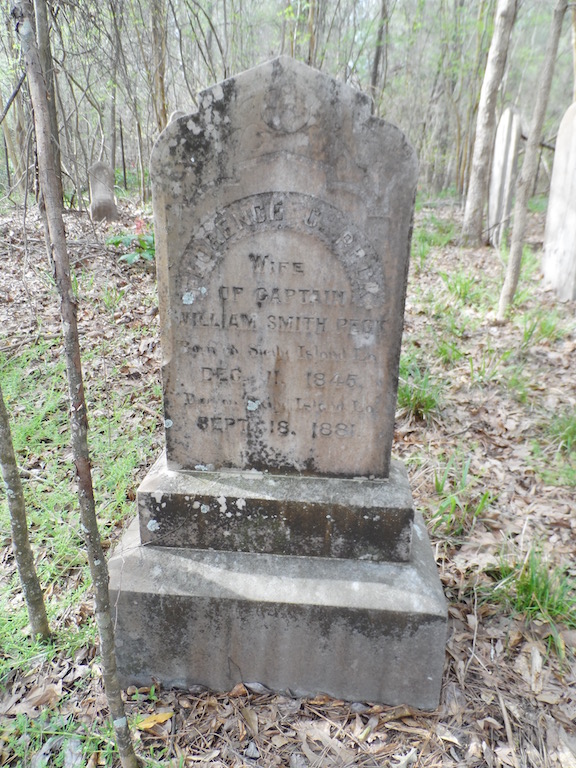
Son, William Smith Peck (1842-1910) and wife, Florence Celeste Lovelace (1845-1881).

Captain William Smith Peck

Florence Celeste Lovelace Peck

Granddaughter, Laura Kirkland Peck (1869-1873); daughter of William Smith Peck and Florence Celeste Lovelace.

Laura Kirkland Peck

Grandson John Lovelace Peck (1871-1872); son of William Smith Peck and Florence Celeste Lovelace.

John Lovelace Peck

Grandson Henry Clarendon Peck (1876-1899), son of William Smith Peck and Florence Celeste Lovelace.

Henry Clarendon Peck

Son, Francis "Frank" Peck (1854-1862)

Francis "Frank" Peck

Also buried in the Peck Cemetery was Harriet P. "Hattie" Lovelace (abt 1847-1885); daughter of John Henry Lovelace and Julia Patience Kirkland; sister to Florence Celeste Lovelace Peck and Amy Lovelace Peck.

Hattie P. Lovelace

November 29, 2012

The Dr. Henry John Peck Family

From Our Island Heritage, Vol. 3, 1978, compiled by Sophie Haley and Mickie Smith:

Dr. Henry John Peck was born on April 29, 1803 in Boston, Massachusetts.  He married Laminda McKinney Smith on December 21, 1828 in Yazoo County, Mississippi.  Laminda Peck inherited Battleground Plantation from her parents, William Mastin and Patience Kirkland Smith.  She and Dr. Henry Peck moved to Sicily Island shortly after they were married.  They had twelve children.  Their son, William Smith Peck, I., has descendants living on Sicily Island and it is this line that will be discussed below.

After having moved to Sicily Island, Dr. Peck represented Catahoula Parish in the Louisiana House of Representatives and later in the State Senate.  He was well known for his contributions toward flood control and the establishment of a free school system in Louisiana.  In 1845, he journeyed to Boston.  While visiting with relatives of his father's dear old friend, John Hancock, they purchased the first free school books to be sent back to Louisiana.

Dr. Henry John Peck died on July 25, 1881.  Laminda McKinney Smith Peck died on December 14, 1871.

William Smith Peck, I. was born on November 22, 1842.  He married his third cousin, Florence Celeste Lovelace, at the Gillis House on December 15, 1868.  William Smith Peck, I. was educated at Center College in Kentucky and was the only Confederate Veteran residing on Sicily Island who was imprisoned during the Reconstruction.  He was apprehended by Federal officers in New Orleans after an illness.

William and Florence had the following four children:
Laura Kirkland, 1869-1873
John Lovelace, 1871-1872
William Smith, II., 1873-1946
Henry Clarendon, 1874-pre-1900
Florence Celeste Lovelace Peck died on September 18, 1881 at her residence on Sicily Island.  William Smith Peck, I. died on December 10, 1910 in New Orleans following a long illness.

William Smith Peck, II. was born on December 27, 1873 and married Barbara Estelle Woodward in Sicily Island on February 1, 1915.  Barbara Estelle Woodward was born on May 8, 1893 at Bayou Barbara, Livingston Parish, Louisiana.  She was the daughter of William Thomas and Rosa Bacot Woodward.

William and Estelle resided in the Lovelace-Peck home on Ferry Plantation in Sicily Island.


Lovelace-Peck Home, 2011


Lovelace-Peck Home, 2011
Ferry Plantation Store, 2011
Lake Lovelace, now known as Lake Louie, 2011


November 3, 2013

Amanuensis Monday ~ The Stories That Should Be Told, Part 21


The following transcription is from a series of recordings my father made in the early 1990s:
I remember seeing old man Will Peck riding his horse around the Peck Plantation.  Sometimes he would ride his horse to town and hitch it right there at a post in front of the bank.  The Pecks owned the bank.  Seems like every time I saw Mr. Will he would always be wearing a seersucker suit.


LtoR:  Will Peck, Estelle Woodward Peck, Will Peck IV, Lucille Steele Ogden

Old bank building left of C.S. Montgomery store
I also remember seeing William Vaught riding his horse to town.  He managed the Peck Plantation for Mr. Will back in the mid-1930s.
The crops they grew on the Peck Plantation were mainly cotton and some corn.  They planted the corn to feed the cattle.  The corn wasn't a money crop.  
Peas planted in corn field
Field peas were planted down in the corn fields.  That was some of the best peas I'd ever eaten. They were little bitty red peas.  Some people called them clay peas.  I wouldn't swap you a bowl of those field peas for a bushel of purple hull peas. Man, they were good!  I don't know what happened to that variety of peas.  I've asked some of the old colored people and they don't know what became of that variety of peas either.
One thing about those corn fields.  You could get lost out in those green, thick fields.  You could walk to the middles of the rows and you'd eventually come out at one end or the other.  But man, what a maze!

Lespedeza
In the fall, the corn would turn brown and dry out.  That's when they gathered the corn.  I can just hear that corn, the wind blowing through that dry corn in the fall.  Those dry corn stalks would rustle and rub together.  
Sounds only country boys or somebody who has been raised on a farm or in a little village would know what I'm talking about.  Moonlit nights, walking down close to a corn field in the fall and hearing those corn stalks rustling and rubbing together.
They also planted oats for cattle.  There was always hay meadows, bermuda and lespedeza.  I believe there were some sorghum grown on the Peck Plantation.  People made syrup from the sorghum.  It wasn't anything to compare with ribbon can syrup.
Back in the 1930s and 1940s everybody had a garden in the spring and early summer.  It was just a necessity.  People planted sweet potatoes at the end of May and first of June.  They would dig them up in the fall and have enough to last them through the winter.
Cushaws
Cushaws and pumkins were also grown.  They didn't have deep freezers back in those days. People canned their food.  
Hot peppers were dried on long strings.  Some people dried okra but I never did know how that worked.  Everybody grew onions and they would store them to last through the winter.
Meat was smoked to cure it.  There was also pickled beef.  People took turns killing hogs and sharing with their neighbors.  One family would kill a hog one week and share with six or seven neighbors. Two weeks later, somebody else down the road would kill another hog and share that with others.
Mosquitoes would eat you up in the summer and the fall.  It would be miserable.  You couldn't sleep at night for those things stinging and biting on you.  
I don't know what was worse, the mosquito bites or that old Flit.  We used to have little spray guns with pump handles on them.  We'd buy mosquito dope called Flit and put it in the spray guns and spray it all in the house.  It would kill the mosquitoes but you could hardly breathe after it was sprayed.
Flit gun
William Peck, Will's oldest son, married my Aunt Nita.  William told me one time that back in the late 1930s and early 1940s there were about seventy-five families living down there on the Peck Plantation.  I didn't doubt it because I'd go to the store, the commissary, on Saturdays and there would be people there getting their pay for working the fields.  Good gracious!  There would be grown people and children everywhere.  I know it was 400 to 500 people coming and going around that commissary.


Store on Peck Plantation aka Ferry Plantation

Mostly black families worked and lived on the Peck Plantation.  There were as many black people living down on the Peck place as there were here in town.  
Here in the village, the largest black family was probably the Cooper family.  There were a lot of Coopers and there used to be a good many Saulsberrys.  I also remember the Thomas family and Bess McIntyre.
A few of the white families working and living on the plantation were the Bowmans, Howards, Matthews, Tews, Crawfords, Juneaus, and Thorntons.
The Bowmans lived on the Peck place behind the high school.  The Crawfords were living in the old Gillis house when it burned down.  A new house was built on the Gillis place and on up in the late 1930s or early 1940s, a fellow by the name of Frank Girault [brother to Emma Cordelia "Deta" Girault] leased or managed the Gillis part of the Peck place. 
Below are snippets from the 1930 U. S. Census for Ward 2, Sicily Island, Catahoula Parish, Louisiana. The first populated column is for the number of the dwelling house in order of visitation and shows the Crawford, Bowman and Howard families living in close proximity to Will Peck on the Peck Plantation.


Note:  Parts 1-20 of 'The Stories That Should Be Told' can be found in the Tags List on the right-hand side of this blog.


April 17, 2014

National Register of Historic Places ~ Battleground Plantation

Battleground Plantation - Courtesy of Dorothy Stutson Tiser

Located 4 miles north of Sicily Island, Battleground Plantation is the site of the last major battle between the Natchez Indians and the French. The battle occurred in January of 1731.  

The land was purchased in 1808 by William M. Smith from John Lovelace, Sr.  In December of 1828, William Smith's daughter Laminda Smith married Dr. Henry J. Peck.   Dr. Peck built the Battleground home in 1829-1830.   It is believed that the house was substantially altered to the present Greek Revival structure around 1850.

From an article on RootsWeb:
The Civil War and its aftermath brought great changes for the Pecks at Battleground.  According to family tradition, Dr. Peck and his wife spent about three years of the war away from Battleground in Cherokee County, Texas.  When the war was over they returned to Battleground, and in a letter of 1867 to former Governor Thomas O. Moore, Dr. Peck expressed his disillusionment in these words:
"I am 65 years of age and was the owner of 90 negroes before the war and a plantation of 2600 acres.  I was making 400 bales of cotton per annum.  I had 500 bales of cotton burned during the war by order of Gen. Taylor with my gin and mill.  I have had two crops of cotton eaten up since the war by caterpillars.  In short I am completely broken up and am disfranchised in consequence of having represented my district in the senate for some years since."
But Dr. Peck was planning to escape the situation:
"I will not submit to Yankee degradation any longer than I am compelled to do so under these circumstances.  I am disposed to emigrate to British Honduras.  I will be greatly obliged to you to give me a letter addressed to the authorities of that country stating my standing as an old citizen of the State of Louisiana."
Dr. Peck never carried out his plan to emigrate, however, for he stayed in Catahoula Parish until his death in 1881.  In the 1870 census, he is listed as a 67-year-old "retired physician" owning 450 acres of land worth $3300.  He also owned 2350 acres of livestock, and during the previous year the farm had yielded 200 bushels of corn and 28 bales of cotton.  The census of 1880 lists Dr. Peck as part of the household of his son, Thomas N. Peck, so he may not have been living at Battleground by that date.
According to family tradition, soon after Dr. Peck's death in 1881, the plantation was sold to a cotton brokerage firm from New Orleans, which in turn leased the land to tenant farmers.  Then, in the early 1900s, it was purchased by Charles Cornick.

De Bow's Review, vol. 12 - Dr. A. R. Kilpatrick visited the battleground site in 1851 and writes about his findings:
"...the remains of a gunlock, some gun flints, a number of ounce balls, all more or less flattened and battered, a piece of iron rod, a copper arrow-barb having a socket to fit on a large arrow, with many of the ordinary Indian flint arrow-points.  Many gun and pistol barrels, fragments of bomb shells and some cannon balls have been picked up on the same ground.  Pigs of lead, two feet long were found there in digging a ditch, and several bars of iron, which were subsequently used by Edward Lovelace in building the first gin erected on Sicily Island.  The musket balls were coated with a thick oxide, and were so plentiful that the early hunters used to resort there for a supply of lead.  A spherical ball was found, having a loop for a handle, and a rattle inside.  Its tone was very clear.  Some gentleman passing there, who had a taste for such curiosities, took it with him.  A part of a steel corn mill was also found, and part of a chain with a hook on it.  One day while fishing, Mr. Peck found the barrel of a pistol sticking in the bank on the border of this lake.  He also found some cannon balls, about eight pounders.  The Indians there in 1802-03, said there were two cannons sunk in the same lake.  The generation of Indians here at this time said they were told by their fathers that the whites and Indians had a battle there more than a hundred years before."

Battleground Plantation was added to the National Register of Historic Places in 1979.

Historic Significance:Person, Event, Architecture/Engineering
Architect, builder, or engineer:Peck,Dr. Henry J.
Architectural Style:Gothic Revival, Greek Revival, Renaissance
Historic Person:Peck,Dr. Clarendon
Significant Year:1850
Area of Significance:Politics/Government, Architecture, Military
Period of Significance:1850-1874
Owner:Private
Historic Function:Domestic
Historic Sub-function:Single Dwelling
Current Function:Agriculture/Subsistence, Domestic
Current Sub-function:Single Dwelling


Courtesy of Dorothy Stutson Tiser

Courtesy of RootsWeb


November 10, 2012

The Mound Building Indians of Peck Village


Peck Mounds Historical Marker
Dr. Kilpatrick writes in 1851 from his history of Catahoula Parish in De Bow's Review, Vol. 12,:
"There are numerous mounds all over the parish, from one side to the other, but the writer doubts their being constructed by the present race of Indians.  They are more likely the work of a far superior race, who have long since passed away, leaving these monuments of their energy and grandeur.  As far as I have been able to ascertain, the present Indian races do not claim any connection with the builders of these tumuli, or pretend to know by whom, or for what purposes they were built.  The works themselves, together with their contents, and relics of pottery etc., show a race superior to our Indians; and I would suggest, that a race which had attained to such skill as these vestiges indicate, would hardly fall back so far as our Indians now are, or were, at the time of the discovery."

March 20, 2015

Pine Hill Plantation House - History and Renovation


The above photograph and the following article written by staff writer, Max Hill appeared in the November 28, 1982 edition of the News-Star World.


Transcription:

It's been a persistent legend in Catahoula Parish for 75 years.

Pine Hill Plantation house - long abandoned and all but forgotten but said to be filled with spirits too restless to accept death.

As far back as 75 years ago, Pine Hill was referred to by local children as the "Haunted House."  Even then, it was abandoned and in a state of disrepair.  

No one lived there as a reminder it had once been the center of a social life with ties to New Orleans and Natchez culture.

No one was there to tell of the days when guests to elegant balls and dinners filled its rooms.
There was only mute evidence that a prestigious family had once called it home, or once filled it with the trappings of Southern aristocracy.

The once-elegant structure was suffering from neglect and the ravages of time.  A tree fell through the dining room windows around the turn of the century, forming a ladder by which vandals and sightseers could enter and pilfer any remaining possessions.

Will Peck, the man who knows more about Pine Hill than any other person in the area - on the basis of family ties and a life-long interest in the house - has taken up residence there.

Peck says he has always heard stories of mysterious phenomena at the house, but reports few unexplainable occurrences have taken place during the five years he has been living there.

Today, there is new life in the house with restoration work in progress.  But still an aura envelops the house, keeping alive the mystery which may have been a key factor in its preservation.

If there had not been rumors of ghosts, the structure may well have been destroyed by scavengers or arsonists.

Lucky for historians that the house still stands, because in addition to the myths surrounding it, Pine Hill played an historic role based on fact.

Norris Springs - 2011
The house is located near one of the most historic spots in Catahoula Parish and northeastern Louisiana--Norris Springs. The natural springs have been mentioned in almost every history of the state as a water source for Indians and local residents.

For unknown centuries, the springs were the center of life for indigenous Indians.  As white men entered the area in the mid-1700s, they were quick to realize the importance of the springs.

Peck says the road which runs directly beside the springs and Pine Hill was an extension of the El Camino Real during periods of high water.


Norris Springs - 2011
The El Camino Real was the main Spanish road that ran from the Mississippi River to Santa Fe, NM. A variety of wayfarers must have stopped to refresh themselves with the icy water as they marched westward.

One of those early adventurers who decided to settle in the area was John Bowie.  He was the original inhabitant of Pine Hill plantation, named it and began the first house there.

Bowie was the uncle of Jim Bowie -- inventor of the Bowie knife -- who met death at the hands of Santa Anna's troops in 1836 at the Alamo Mission in San Antonio.

The younger Bowie was a resident of Catahoula Parish and a frequent visitor to Pine Hill Plantation.

John Bowie sold the plantation in 1822 to Zachariah Kirkland, who completed the current structure in 1825.  The house was built on a portion of an original Spanish land grant.

Pine Hill house is built in a style known primarily in the West Indies, the most important of a number of reasons the house is noteworthy in Louisiana architectural circles.

It was constructed high on a hill which overlooked the entire farm.  Main floor rooms are elevated over two brick basements.  There are five rooms and an enclosed porch upstairs.

The unusual basements were utilized mainly for storage in the days when a plantation had to be completely self-sufficient.  Still intact are bars over the windows to prevent animals from entering the food supply rooms.

Peck says the West Indies architecture was unusual in this part of the state; however, he adds, there was a rational explanation for its utilization at Pine Hill.

"These people were closely akin to the Spanish in New Orleans.  Governor Gayosa was responsible for many of the land grants here and on Sicily Island," he says.

Kirkland lived at Pine Hill until his death a decade later.  His widow, Harriet Perry Kirkland, lived there until her death past the age of 90.

Following the death of Mrs. Kirkland's first husband, she married a "Dr. Norris," who bequeathed his name to the house, springs and community.

Mrs. Norris was well known throughout the state as one of the wealthiest women of her day.  She was also acquainted and related to many prominent people throughout the state.

The house was refined with imported millwork and conveniences during the time Dr. and Mrs. Norris lived there.  A brick-paved circular driveway, complete with carriage landing, was constructed.  The original brick walk has been unearthed during recent renovations.

There also was a continuous stream of interesting people visiting there during Dr. Norris' lifetime. Stephen F. Austin stopped on his way to Texas long enough to borrow money to finance the remainder of the journey.  He left his desk with the family as collateral, Peck says.

Mrs. Norris was considered the matriarch of many Catahoula Parish families.  She was a staunch supporter of the Confederacy during the Civil War and on occasion hid Rebel troops in her brick storerooms.

Confederate agents, scouting out the countryside following the fall of Louisiana, camped on her property, Peck said.

"She was really taking a chance in allowing this.  If the Federals had found out, she could have been ruined," Peck says.

During Reconstruction, the house was used as a relay station in a most unusual spy network.
Federal officials, anxious to arrest pro-Southern sympathizers, made several fruitless trips to Catahoula Parish.

"They never could figure out why the prominent men always eluded capture," Peck says.

According to local legend, a woman in Monroe who owned a river boat alerted the Southerners to impending danger.  She would travel by boat to Boeuf Prairie in Franklin Parish and send a relay messenger to Mrs. Norris at Pine Hill.

"This Belle Watling-type character saved many Catahoula men from Yankee jails," Peck says, referring to the classy madam in "Gone With The Wind."

Social events for which Mrs. Norris had been famous continued at the house until the early 1900s. Dances were held in the upstairs rooms for the young people of Sicily Island.

And then, around the turn of the century, a young man who had only recently moved to the area was murdered at the house.

Peck said that a "Mr. Stewart" had come to Catahoula with the gas industry.  In the short period he was there, he gained the respect of area residents.

One ill-fated night, he escorted a young Sicily Island woman to the Pine Hill dance.  Unknown to the young couple was the fact that a local youth was in love with the girl.

He waited outside the house for them to leave the dance.  As they walked onto the front steps, Mr. Stewart was mortally wounded.

The murderer mounted his horse and vanished into the night, according to one popular version of the story.

"The young girl was totally innocent, that was the irony of the entire matter." Peck says.

After Mrs. Norris' death, Pine Hill remained an empty shell for a number of years.  From time to time, tenants would live there, but never for any great length of time.

But work is currently underway to restore the front veranda and to repair other deteriorating features.
Peck intends to open the house to the public for seven months during the New Orleans World Fair in 1984.  He plans to make available the upstairs to overnight guests who wish to take a trip into the past.

Whether there are ghosts at Pine Hill remains a mystery.  Peck will not comment on any unusual happenings during his time at the house.

"Ghosts?  All I can say is Grandmother Norris has to be here.  Without her, the house would never have survived," he says.

Pine Hill Plantation House - 2011


Newspaper article and photograph are courtesy of Karen Barron Egloff.

September 8, 2014

Amanuensis Monday - The Stories That Should Be Told, Part 55


The following transcription is from a series of recordings my father made in the early 1990s:
Mildred had cooked some turnip greens, cornbread and sweet potatoes.  I went over and picked up Emily Cooper to come eat with us.  John Gary came by while we were visiting and brought us some more sweet potatoes. 
We had a good visit and some good conversations.  We must have talked for about two hours.  John will be seventy-six on June 19, 1992.  Emily will be seventy on January 2, 1992.  I’ll be sixty-five on June 3, 1992 and Mildred will be sixty-six on July 22, 1992.  We are all about the same age. 
John Gary cooked for the Peck family.  He had been going to the Peck home since he was just a little boy with his mother and grandmother, Aunt Jo.  I remember John’s grandmother, Aunt Jo.  
Peck Home where John Gary cooked for the family

I reckon he cooked for the Peck family for over 50 years.  He could have gone down to New Orleans or to some other city and been a chef in one of those big, fancy restaurants.  He was a wonderful cook and was known far and wide for his talents in the kitchen.  I asked him why he never left and pursued a chef’s job and he said he was happy right here on the Island.
John told me something I didn’t know about Aunt Hester Robinson who I had mentioned on an earlier tape.  Aunt Monk and Uncle Truman Hunter lived over in the ‘Ville’ for years and years.  Aunt Monk and Aunt Hester were sisters. 
Aunt Monk raised the Saulsberry children.  I believe they were her nieces and nephews.  Their names were Sadie, President, Alec and Walter.  The house they all lived in has been gone for years. 
John Gary asked me if I remembered when one of Uncle Buddy and Elizabeth Fair’s daughters was killed.  She was married to old man Wes Hence.  They were all in the field working when a colored man named Jim Butler pulled a pistol and shot and killed her.   I remembered hearing about it but I don’t know if it was before or after I was born.  
I did remember when Brady Skinner killed Wes Hence some years after this shooting.  Wes was supposed to be bad and a lot of people were scared of him.  He had been threatening what he was going to do to Brady who was just a young man.  
Brady hid in some bushes down the lane that ran behind the Peck place near where John Gary now lives.  He had a club of some kind and waited for Wes to walk by.   He jumped out and hit him with the club and killed him.  
John said the strange thing was that where Wes was killed was no more than 75 yards from where Jim Butler had killed Wes’ wife. 
John asked what kin Dorse Kent was to Rose.  I told him they were brother and sister.  He didn’t know that.  It just goes to show that when a few people sit around and visit we get more information.  
We talked about Bill McGuire who worked for the Pecks.   Old Bill was part Indian.  He lived with Liddie Ann Thomas who was the daughter of Otilla and Buck Thomas.  Bill stayed around the club camp on the lake.  He rented out boats, cabins, and ran the camp for the Peck family.  He did all the cooking for the big picnics and political rallies that were once held at the camp. 
Bill McGuire came to Sicily Island from Oklahoma with Zack Miller and his family.  Zack Miller came here after buying land and building the 101 Ranch in the early 1900s.  He was good friends with old man Peck. 
Zack’s son, Little Zack, is still living and comes to visit Marvin Nolen every year.  As long as Bill McGuire was living, Little Zack would go see him on the Peck place.  He called him Uncle Bill.
I believe Little Zack and his sister, Blevins, came down here and stayed with the Peck family one summer a long time ago.

John Gary passed away on April 4, 1999 and is buried alongside his wife, Velma, and his son, John, Jr. in Pilgrim Cemetery, Sicily Island, Catahoula Parish, Louisiana.


Note:  Parts 1-54 of 'The Stories That Should Be Told' can be found in the Tags List on the right-hand side of the blog.

May 13, 2016

Pre-Civil War Quilt Found in Sicily Island

From an article published in the Concordia Sentinel on November 30, 1994:

Transcription:

Pre-Civil War quilt found in Sicily Island

A very old quilt, pre-dating the Civil War, was found recently by Mrs. David (Theresa) Stafford IV, of Sicily Island, between the springs of a bed which had been passed down through the Stafford Family.

Concordia Sentinel - 11/30/1994

No one seems to know the exact route this quilt has taken before surfacing some 136 years since it was made.

The pattern seems to be what today might be called a friendship quilt, where each person who makes a square signs his name.

Although many of the names are illegible, some are still quite clear.

The names, hometowns and dates which are readable include:  Mrs. L. O. Lovelace of Sicily Island; Mrs. Bettie B. Peck of Sicily Island; Mrs. W. L. Ditto, December 20, 1858; G. Holstein, October 26, 1858; Carrie, October, 1848; and Jane, December 1858.

This quilt with its authentic signatures and dates bespeaks the early history of Sicily Island, for the Lovelace brothers are reputed to be the first permanent settlers on the island.

The two brothers arrived in 1776, secured a Spanish land grant and built their first home, a crude log structure near the heart of a lake.  That lake is still occasionally referred to as Lake Lovelace.

By 1798 John Lovelace had built a better home for his family, which today is known as Ferry Place.  He reared 12 children, all of whom lived on the island.

Eventually a grandson, also named John Lovelace, inherited the property and lived there with his wife, Louisa Holstein.  They both died in 1826, leaving behind a son, another John Lovelace.

This third John Lovelace was married to Patience Kirkland, daughter of Zachariah Kirkland.

Zachariah Kirkland lived at Pine Hill Plantation which he bought from John Bowie (brother of Jim Bowie) in 1825.

John and Patience had three daughters, Florence Celeste, who married William Smith Peck I; Amy, who married Capt. Dave Stafford; and Harriet, who never married.

Although there are many descendants of the original Lovelace brothers living in Sicily Island today, there were very few male heirs, so Lovelace as a last name has disappeared from the area.

Lovelace descendants include Peck, Holstein, Enright, Stafford, Peniston, York, Krause, Doniphan and others.

~~~~~

There are only two names that I can confirm, Mrs. Bettie B. Peck and Mrs. W. L. Ditto.

Mrs. Bettie B. Peck was Elizabeth Bettie Smith.  She was born on December 31, 1839 and died on October 7, 1871.  Per the Peck family Bible, Bettie married John Gilman Peck, Sr. on December 9, 1857.  She and her husband are buried in the Old Peck Cemetery near Sicily Island.

Mrs. W. L. Ditto was Levinia Holstein.  She was born in 1835 to the marriage of David Gibson Holstein and Camilla C. Lightner.  On January 31, 1855 Levinia married William Lego Ditto, Jr. in Catahoula Parish.


The other four names are questionable.

Mrs. L. O. Lovelace 
I do not have a record of a Lovelace male with initials L. O.

G. Holstein
Numerous Holstein men shared the middle name of Gibson.
Celeste E. Hooter, daughter of Nancy Lovelace and Michael Hooter, was married to King Gibson Holstein circa 1823.  G. Holstein could stand for Mrs. K. G. Holstein.  
As mentioned above, Levinia Holstein was the daughter of David Gibson Holstein and Camilla C. Lightner, so this could possibly be Camilla aka Mrs. D. G. Holstein.

Carrie
Possibly Caroline "Carrie" Narcissa Desha who was born circa 1838; making her only 10 years old when the quilt was made.  She was the first wife of David Stafford.  This could explain the quilt being handed down through the Stafford family over the years.

Jane
Possibly Jane Catherine Lovelace who was born in 1814 to the marriage of George Washington Lovelace and Sophia Dorcas Wells.  She married Benjamin Philip Cuny circa 1832.


If anyone has information on the location of the original quilt and/or the names in question, please leave a comment in the comment section below or email me at rootsfromthebayou@gmail.com.


November 28, 2012

The Lovelace Family


The Lovelace family were the first permanent settlers on Sicily Island.  John Lovelace, Sr. was born in Virginia on December 28, 1740.  He married Anne Hughson, daughter of Edward and Anne Washington Hughson.  Anne was born on Popes Creek, Westmoreland County, Virginia, on December 4, 1742.  


Above is a sketch of the first home built by the John and Anne Lovelace.  The log cabin was located near the present township of Sicily Island, at the head of Lake Lovelace.  The original house had only two rooms.  Later, an open hallway and two more rooms were added.  These were of clapboards.  There was a fireplace at each end of the house.  A front porch was built all the way across the length of the house.  The water supply in the early days was from a cistern nearby.  

William Smith Peck (1842-1881) and his wife, Florence Celeste Lovelace (1845-1881) made their first home here when they married in 1868.  Florence was the great granddaughter of John, Sr. and Anne Lovelace.  They later sold the small house and property to a relative, Zachariah Kirkland.  The property and house were later owned by John Peck, an uncle to William Peck.  Thus it is identified as the John Peck Place. 

September 9, 2014

The Organization of the Sicily Island State Bank

Sicily Island State Bank in background - circa late 1950s

The original Charter of the Sicily Island State Bank was filed on April 26, 1918.  Directors, officers and stockholders were listed in Article 7 of the charter.

Directors
Thomas Jefferson Chisum, Sicily Island
William Smith Peck, Sicily Island
Charles Acia Cornick, Sicily Island
Henry Guice, Sicily Island

Officers
William Smith Peck, President, Sicily Island
Thomas Jefferson Chisum, Vice President, Sicily Island
Fred Falkenheiner, Cashier, Vidalia


Stockholders:  Yancey Brothers, Kleiser & Causey, Thomas Jefferson Peniston, Henry J. Disch, Clarence Edward Enright, Charleas Acia Cornick, Yelverton Bondurant, H. B. DeWitt, Edgar E. Garrison, Henry M. Krause, Zebulon York, Sr., W. T. Woodward, Dave Stafford, J. A. Kiper, William Smith Peck, Thomas Jefferson Chisum, Isham Alfonso "I. A." Steele, Henry E. Guice, W. A. Squyres, E. D. Miles, John Henry Knight, Edward Dorsey Smith, John W. Peniston, L. Saltzman, Edmon Chambers, A. F. Patterson, Felex Burt, C. W. Rogers, Willie Woodward, Myrtis Woodward, P. H. Wailes, Estelle Woodward Peck, Charles J. Gordon, Augustus "Gus" S. Krause, J. W. D. Summers, Fred T. Chambliss, Gladys Kendrick, Sadie Kendrick, Edward Walling Chisum, Laura Ballard Chisum, Elijah V. Bourke, Henry Peniston, David P. Ford, Fred Korn, C. R. Wilson, Lee W. Furr, Pearl Ensminger Bondurant, John C. Hardin, Sr., Thomas L. McKay, Joseph S. Francis, F. H. Grayson, Thomas C. McKay, A. Lenigam, Dwight E. Woodin, W. E. McGraw, Thomas Benjamin Gilbert, J. M. Henagen, P. V. Leddell, L. L. Anding

Sicily Island State Bank - 1978 
Many a high school homecoming parade was viewed from the concrete sidewalk that ran in front and down the side of this building in the 1960s.  One memory that stands out in my mind is the silver aluminum Christmas Tree that always graced the windows of this building during the Christmas season.

Back in the 1960s, there were no drive-through windows and there certainly weren't any ATM machines.  I remember it being a big deal when an after-hour deposit slot was installed on the side of the building.

Below is a photograph of my grandfather, Bruce Edmonds, who was a cashier at the Sicily Island State Bank for many years; beginning in 1944.  He was also the son-in-law of one of the original directors and stockholders, Isham Alfonso "I. A." Steele.

A portrait of the founder of the bank, Williams Smith Peck can be seen in the background of the photograph.

Ken Clark, Miss Laura "Hat" Harris and Will Peck, IV worked in the bank during my grandfather's tenure.  I also remember Mrs. Patsy Jackson and Mrs. Evelyn Miller being cashiers some years later.

Bruce Edmonds, Cashier - Sicily Island State Bank

The photograph below was taken in 2010.  The Sicily Island State Bank building has been remodeled and enlarged to include a drive-through window.

On the left side of the photograph you can see a separate building across the street which has now become part of the bank.  Years ago, this building was the Pan-Am Station.  If you look just over the shoulders of the men in the top photograph, you can see the station and part of the name.

Sicily Island State Bank - 2010


Source:  A History of Sicily Island, Will S. Peck, IV