Showing posts with label Hog Dogs. Show all posts

July 13, 2015

Louisiana Hog Dogs Back to Work - 1950

The following article appeared in the March 31, 1950 edition of the Altoona Mirror in Altoona, Pennsylvania:

Transcription:

Louisiana Hog Dogs Are Put Back to Work
By William Johnston


Jonesville, La.--The floods brought a new moment of glory back for the hog days of Catahoula parish, a vanishing breed that is the pursued instead of the pursuer.

Once more the dogs were out in the pecan and oak woods, looking for droves of hogs, turned out to fatten on the pecans and acorns, and wild after a few months of freedom.
As soon as the dogs found a drove of hogs they started nipping at the meanest looking boars they could find.  It was for the good of the hog, which would have drowned if the floods caught them.
But the boars, with savage grunts, took out after the dogs with all the sows, shoats and pigs following them.  The dogs led the hogs into pens and jumped into the clear on the other side.
Farmers closed the gates in the pens.  Thus some thousands of hogs were saved from the floods.  The renaissance of the hog dogs brought a touch of nostalgia back to Allen J. Swayze, aged 75, a retired Catahoula parish stockman.
Three generations ago there were three big families in Catahoula, the Swayzes, McMillans [McMillins] and Alexanders, and they probably developed the hog dog.
Thirty years ago the Swayzes, McMillans [McMillins] and Alexanders owned 30,000 hogs among them.  Everybody in Catahoula parish doesn't own that many hogs now.
"All this high water and the bad feeding just don't make woods hog raising as good as it was," Swayze said.  "They still got a few dogs that can work hogs.  But nothing like we used to have."
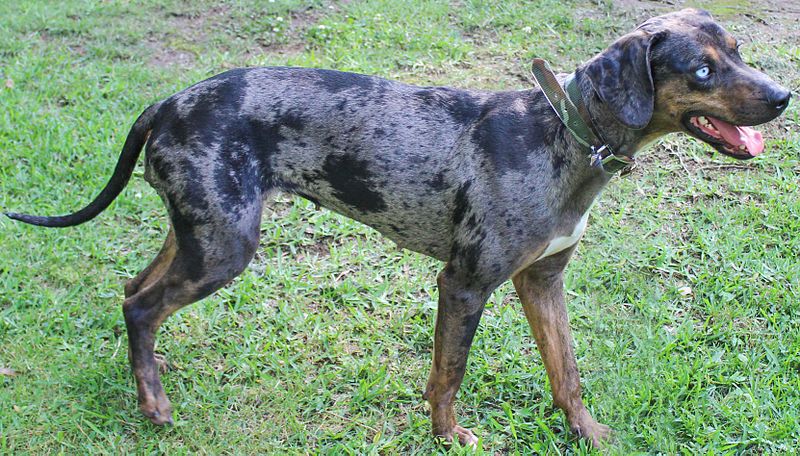
"A good hog dog might be yellow or leopard or have dark blue spots on a white or gray coat--look something like a hound, weigh about 60 or 70 pounds."


Altoona Mirror - 3/31/1950


"But a good hog dog won't have any hound blood at all.  Hound blood ruins a good hog dog, makes him timid.  They ain't exactly a breed.  We just call them curs.  But the best ones usually have glass (light colored) eyes."
"You have to train a hog dog a little.  But he takes natural to finding and driving woods hogs."
"I guess the best ones I ever had were a female named Tollie and a couple of males, Ring and Drummer.  Two or three of us neighbors would saddle up and take the dogs out in the swamp.  Tollie was a good find dog.  She'd locate a herd on a ridge and start circling."
"No barking, like hounds, unless we on the horses didn't know where they were.  Then the dogs would bay.  Drummer was my driving dog.  When the herd was pretty well gathered up, I'd yell at Drummer to get up front and start moving them."
"Drummer would nip and the boars and lead sows and all those hogs would rally, their tails rubbing and their faces pointed outward.  They'd lunge at Drummer and he'd take off in the direction we wanted to go.  Tollie and Ring would be follow dogs."
"If a hog tried getting out of the herd, he'd get chased back.  We'd move along like that as much as five miles.  Two dogs can handle as many as 100 hogs and not lose a single one."


June 17, 2014

1896 Article on Cunning Louisiana Dogs

The following article appeared in the May 3, 1896 edition of the New York World:


Transcription:

HOW FEROCIOUS WILD HOGS ARE LURED TO CAPTURE BY CUNNING LOUISIANA DOGS.
N Louisiana wild hogs are captured as in no other part of the world.  The hunter's chief duty is to sit on a fence while an intelligent dog does all the work.
In Catahoula County is a peculiar breed of canines known as the hog dog.  Their ancestors herded and hunted wild hogs many years ago and so strongly has the instinct been developed that the present strain needs no training whatever.  They take as naturally to "rounding up" wild hogs as a spaniel to water.
The wild hog of the Louisiana canebrake is an animal to be shunned by everyone not clad in steel armor.  He is as fierce as a mountain lion and absolutely tireless in a fight; very aggressive, and needs only a hint to arouse his fighting temper.  Louisiana hunters treat the hog with great respect until he is securely trapped.  Then they shoot and eat him.
In the thick woods of Catahoula County are large herds of these wild razorback hogs.  To hunt them afoot, even when armed with a rifle, is an unpleasantly dangerous sport.  A good marksman might easily kill one wild hog, but if charged by a drove, the top of the nearest tree would be the safest retreat for him.  At the same time, the flesh of the wild hog is very good---if there is no wild turkey---and so this is the way the shrewd Louisiana planters secure their quarry.
The trained hog dog, at the signal of his master, goes scurrying off in the woods much as a sheep dog goes after a flock of lambs.  The dog hunts about, barking and yelping furiously.  Wild hogs object to the society of dogs and so before long a herd of wild hogs is rounded up prepared to argue the question.
The dog, still barking loudly, pretends to rush furiously at the hogs.  He is trained to do that. When a few yards away he turns and retreats.  The hogs accept the challenge and give chase.
On the outskirts of the woods a large pen is built with one gate.  If the dog is a good one--and all hog dogs are said by Louisiana hunters to be good--he has no trouble in leading the infuriated razorbacks directly to this coral.
The dog dashes into the corral, the wild hogs, blind with rage and anger, following closely behind. Once within the bars the dog jumps over the fence, while the hunter, who has been sitting patiently all this time on the fence, jumps down, shuts the gate, and the wild hogs are prisoners. They cannot jump the fence, which is the only restraint that baffles an agile razor back.
Wild hogs are very dangerous when wounded.  Instances of rash hunters being killed by a herd have not been infrequent.  The hogs have very long fangs, which they use as fiercely as the incisors of a tiger.  It is said that wild hogs will eat human flesh with great relish, and once they have tasted it their appetite for it is as insatiable as a man-eating tiger.

August 12, 2013

Catahoula Hog Dog

From an April 6, 1896 article in the New York Tribune:

Courtesy of Chronicling America
Transcription:
From The New-Orleans State.
A few weeks ago we had occasion to publish, on the authority of our friend, Colonel E. H. Lombard, a very interesting narrative regarding the celebrated hog dog of Catahoula, and so remarkable were the performances of this dog, as related to us, that many of the deacons of the church, as well as personal friends of Colonel Lombard, did him the injustice to class him as a romancer.  We are glad to be able to state, however, that Colonel Lombard's story has been corroborated in every particular by no less an authority than Wash Wiggins, one of the best-known citizens of Catahoula parish.  Mr. Wiggins says, and he has signified his willingness to be quoted, that the hog dogs of Catahoula are the most intelligent animals on the face of the earth, and as their ancestors before them were hog herders, they take to the work without any training whatever.
It is claimed that the wild hog of Catahoula is second only in the matter of pugnacity and ferocity to the roaring tiger of the Bengal jungle.  In order to get a drove of these hogs into a pen, the hog dog of Catahoula, as Mr. Wiggins informs us, operates as follows:  Keeping always in mind the direction of the pen or corral, the dog goes into the woods and flushes a drove of hogs.  Then, keeping himself invariably in front of the hogs, barks forth a challenge; the hogs accept the gauge of battle and make a dash for the enemy, and the dog, tucking his tail, if fortunate enough to have one, which is seldom the case, skedaddles toward the pen, regulating his speed so as to save at all times a distance of about thirty yards.
Should the hogs halt in their pursuit, the dog returns and renews his dare, and again he is charged, and again he slopes.  In this way he lures the hogs on until in their mad chase they follow him through the open gate into the pen, when he immediately proceeds to jump the fence on the opposite side, while his master, who has been seated on the fence during the pursuit, whistling and shooting tobacco juice at passing bumblebees, hurriedly climbs down and closes the gate on the entrapped porcines.  The faithful and intelligent dog, which is found nowhere else but in the languorous shades of the Catahoulan wilds, is rewarded with a pone of cornbread, and the next day there is a great hog-killing time, followed by feasting and revelry.

Catahoula Hog Dog aka Catahoula Leopard Dog aka Catahoula Cur